
Table of Contents
Introduction
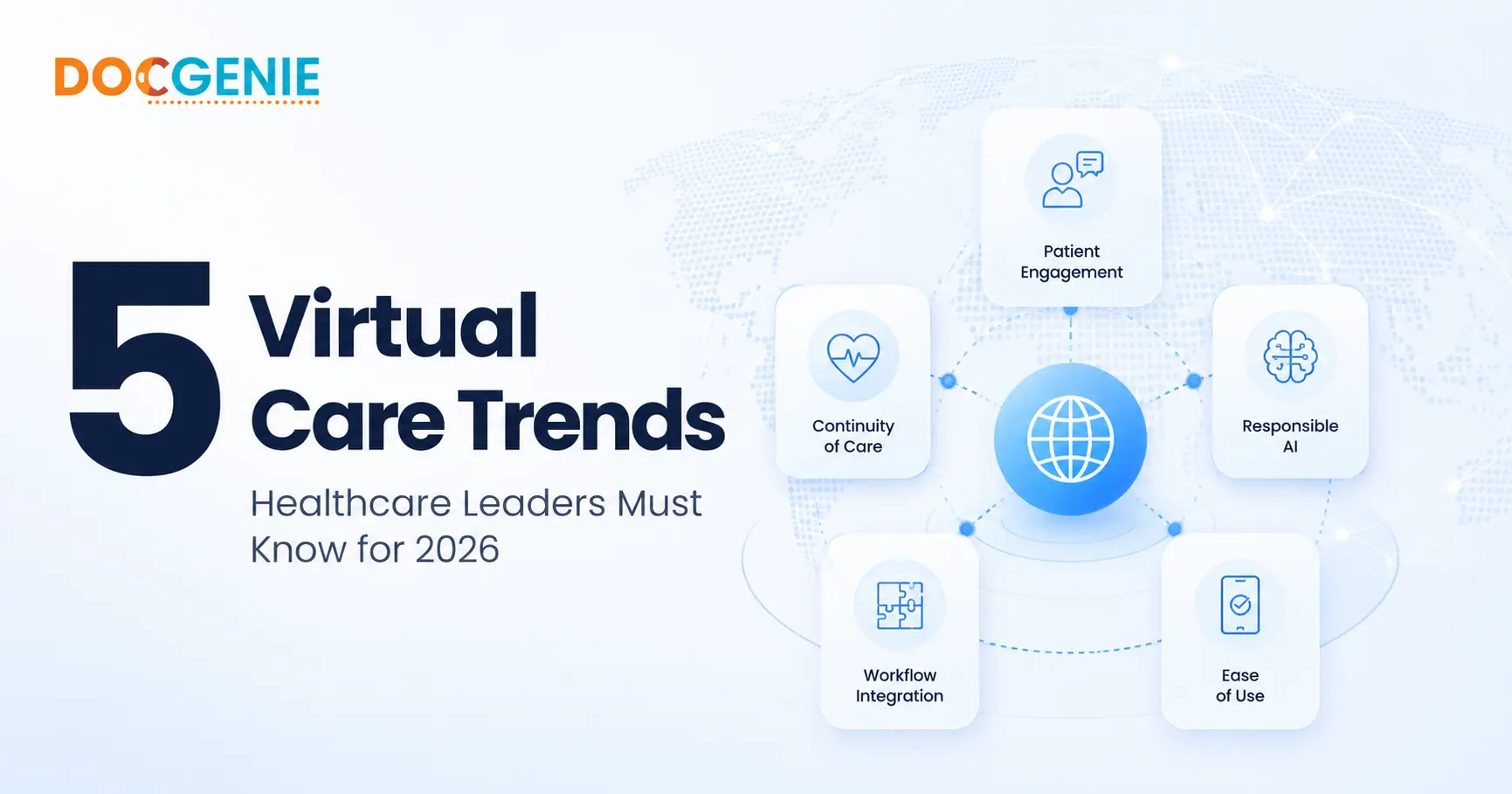
Explore 5 key virtual care trends for 2026, including patient engagement, continuity of care, responsible AI, workflow integration, and ease of use.
5 Virtual Care Trends Every Healthcare Leader Must Know for 2026
Virtual care has moved far beyond the emergency adoption phase of the pandemic years. In 2026, healthcare leaders are no longer asking whether digital care has a role to play. They are asking how to make it safer, more connected, more compliant, and more valuable for both patients and providers.
The shift is clear. Patients expect convenient digital access to care. Doctors need tools that reduce administrative workload instead of adding to it. Clinics, hospitals, and healthcare networks want systems that support continuity of care, not just one-off video calls. Regulators are also placing greater emphasis on data privacy, AI governance, security, and clinical accountability.
For healthcare providers, healthcare technology vendors, and ecosystem partners, this creates a major opportunity. A strong virtual care platform can improve access, support better follow-ups, strengthen patient engagement, and make care delivery more efficient. But success depends on choosing technology that is secure, scalable, compliant, and designed around real healthcare workflows.
Here are five virtual care trends every healthcare leader should know in 2026.
1. Virtual Care Is Becoming a Must-Have, Not a Nice-to-Have
Virtual care is no longer an optional digital feature. It is becoming part of the baseline healthcare experience.
Patients increasingly expect healthcare providers to offer digital access alongside in-person care. Online appointment booking, secure messaging, digital payments, remote consultations, e-prescriptions, and automated follow-up reminders are now seen as part of a modern patient journey.
This shift is being driven by the broader consumerization of healthcare. Patients are used to digital-first experiences in banking, travel, retail, food delivery, and professional services. They expect convenience, transparency, speed, and personalization. Healthcare is no exception.
For many patients, a clinic that only offers in-person appointments may feel less accessible than one that gives them the option to consult remotely when appropriate. This is especially relevant for follow-up visits, chronic care management, second opinions, mental health support, lifestyle care, post-procedure reviews, elderly care, and non-emergency consultations.
Patient acceptance of digital health has also matured. People no longer see virtual care as a temporary substitute. They expect it to be secure, easy to use, and integrated with the rest of their healthcare journey.
A 2026 telehealth industry report found that patient engagement is the top strategic priority for virtual care leaders, with 55% naming it as their primary focus. This reinforces how important patient experience has become in virtual care strategy.
For healthcare leaders, the message is simple: virtual care is now part of competitive healthcare delivery. Providers that fail to offer a strong digital care option may risk losing patient loyalty, missing follow-up opportunities, and creating unnecessary friction in the care journey.
2. Continuity of Care Is Becoming the Core Objective
In 2026, virtual care is not just about enabling online consultations. The bigger objective is continuity of care.
This is an important distinction. A consultation over a consumer video tool may solve the immediate need to speak remotely, but it does not automatically create a structured clinical workflow. It does not maintain a centralized medical history. It does not connect prescriptions, appointment calendars, EMRs, vitals, referrals, payments, and follow-ups into one care journey.
A modern virtual care platform should function as an end-to-end digital clinic. It should support the full patient lifecycle, including:
This is where virtual care becomes truly valuable.
When doctors can track patient progress over time, review previous consultations, monitor clinical parameters, access past prescriptions, and identify early warning signs, digital care becomes much more than a convenience channel. It becomes a tool for proactive and continuous healthcare delivery.
This is especially important for chronic disease management, elderly care, maternal health, mental health, post-operative monitoring, and long-term medication adherence. In these cases, the quality of care depends heavily on what happens between consultations.
Healthcare leaders should therefore evaluate virtual care platforms based on how well they support continuity, not just whether they support video calls.
A strong virtual care setup should help answer important questions:
Can doctors easily view the patient’s medical history?
Can patients access past prescriptions and reports?
Can care teams trigger automated reminders?
Can vitals be tracked remotely?
Can another doctor take over with enough clinical context?
Can the platform integrate with related healthcare services?
If the answer is yes, the platform is supporting real continuity of care.
3. Healthcare Organizations Are Becoming More Cautious About Unchecked AI Rollouts
AI will continue to shape healthcare, but 2026 is likely to be defined by a more cautious and governance-led approach.
Healthcare providers, governments, and regulatory bodies are increasingly aware that AI tools cannot be introduced into care delivery without proper guardrails. In healthcare, AI does not just influence convenience or productivity. It can affect triage, diagnosis support, treatment pathways, resource allocation, clinical risk, patient trust, and health equity.
The key concern is dependency. Once AI tools become embedded in everyday clinical workflows and doctors or patients begin relying on them, it becomes much harder to manage the consequences if the technology is biased, inaccurate, poorly governed, or insufficiently validated.
Regulators are already responding to this reality. The European Union’s AI Act entered into force on August 1, 2024, and is designed to support responsible AI development and deployment. For healthcare, this is particularly relevant because many AI systems used in regulated products and clinical settings may face specific obligations as the law becomes applicable in phases.
The World Health Organization has also emphasized the need for AI in health to be safe, ethical, equitable, and governed in a way that benefits patients and societies. Its AI-for-health work focuses on safety, equity, responsible innovation, and public benefit.
This does not mean healthcare leaders should avoid AI. It means they should avoid rushing into AI adoption without a clear governance framework.
Before adopting AI in virtual care, healthcare organizations should ask:
For 2026, the winning approach will not be “AI everywhere.” It will be responsible AI where it clearly improves care, reduces risk, supports clinicians, and operates within strong governance structures.
4. Virtual Care Must Integrate With Existing Critical Workflows
One of the biggest myths holding healthcare providers back is the belief that launching a digital clinic means replacing everything that already works.
In most cases, that is not true.
A strong virtual care setup should not force clinics, hospitals, or healthcare networks to abandon all existing workflows. Instead, it should integrate with the critical systems and practices that already support effective care delivery.
The goal of virtual care is not disruption for the sake of disruption. The goal is to make healthcare delivery more efficient, accessible, secure, and scalable.
For example, a clinic may already have a preferred EMR system, established doctor schedules, billing processes, patient communication habits, internal referral pathways, and administrative workflows. A good virtual care platform should be able to work with these existing processes wherever possible.
It should replace inefficient parts such as manual appointment coordination, fragmented communication, paper prescriptions, repeated data entry, disconnected records, and unclear payment tracking. At the same time, it should preserve the parts that already support clinical quality and operational stability.
This is why integration matters.
Healthcare leaders should look for digital clinic software that supports:
The strongest platforms do not ask providers to choose between their current practice and digital transformation. They help providers bring the best of both together.
For healthcare organizations planning a virtual care rollout in 2026, the key question is not, “How do we replace our existing setup?”
The better question is, “Which parts of our current setup should we keep, and which parts should technology make faster, safer, and easier?”
5. Ease of Use Still Reigns Supreme
Despite all the progress in digital health, one factor remains consistently important: ease of use.
A virtual care platform can be sophisticated, secure, and feature-rich, but if patients and doctors struggle to use it, adoption will suffer.
This is especially important in healthcare because users are often under pressure.
Patients may be unwell, anxious, elderly, digitally inexperienced, or managing care for a family member. Doctors may be moving between back-to-back consultations, clinical documentation, patient follow-ups, and administrative tasks. Admin teams may be managing high appointment volumes, payments, refunds, reports, and doctor schedules.
In this environment, complexity becomes a barrier.
A good virtual care platform should feel intuitive. Patients should be able to register, book appointments, upload records, join consultations, access prescriptions, make payments, and receive reminders without confusion.
Doctors should be able to view patient history, manage consultations, issue prescriptions, write notes, refer patients, and follow up without unnecessary clicks or duplicated work.
Admin teams should be able to manage scheduling, payments, refunds, doctor payouts, reports, and communication from a clear dashboard.
Ease of use is not just a design preference. It directly affects adoption, retention, efficiency, and patient satisfaction.
In 2026, healthcare leaders should prioritize virtual care platforms that are not only powerful, but also simple enough for real-world clinical environments.
What These Virtual Care Trends Mean for Healthcare Leaders
The direction of virtual care is clear.
Healthcare organizations are moving away from disconnected tools and toward secure, centralized, and integrated platforms. Patients expect better digital experiences. Doctors need workflows that support clinical efficiency. Admin teams need visibility. Regulators expect stronger data governance. AI adoption must be responsible. And platforms must be easy enough for daily use.
For healthcare leaders, this means virtual care should be treated as a long-term infrastructure decision, not a short-term software purchase.
The right platform should help answer four strategic questions:
If a platform cannot support these goals, it may not be suitable for the next phase of virtual care.
How DocGenie Global Can Help You Build for the Next Phase of Virtual Care
DocGenie Global helps healthcare providers, vendors, and ecosystem partners launch secure, branded virtual care solutions without building technology from scratch.
With DocGenie Global, healthcare organizations can create a customized white-label telemedicine platform that supports:
The platform is designed to help healthcare providers move beyond basic online consultations and build a more complete digital clinic experience. It supports continuity of care, operational efficiency, secure workflows, and a branded patient journey that can be launched quickly and scaled over time.
DocGenie Global is headquartered in Singapore and supports healthcare providers and ecosystem partners across 50+ countries. Its platform is HIPAA-compliant, SOC 2 Certified, and ISO/IEC 27001:2022 Certified, as stated in the provided company content.
For healthcare leaders preparing for 2026, the priority is clear: virtual care must be connected, compliant, easy to use, and built for long-term care delivery.
Final Thoughts
Virtual care in 2026 is not just about offering remote consultations. It is about building a secure, connected, and scalable digital care ecosystem.
The healthcare organizations that succeed will be those that move beyond basic video calls and invest in platforms that support the full patient journey. This includes continuity of care, secure data management, responsible AI adoption, workflow integration, and intuitive user experience.
For clinics, hospitals, healthcare networks, and digital health vendors, virtual care is no longer a side channel. It is becoming a core part of modern healthcare delivery.
The next phase belongs to providers that can combine convenience with trust, technology with clinical workflows, and digital access with long-term patient care.
Frequently Asked Questions
What are the top virtual care trends for 2026?
The top virtual care trends for 2026 include stronger patient engagement, continuity of care, responsible AI adoption, integration with existing healthcare workflows, and improved ease of use for patients, doctors, and admin teams.
Why is virtual care becoming important for healthcare providers?
Virtual care is becoming important because patients expect convenient digital access, doctors need more efficient workflows, and healthcare organizations need scalable systems for follow-ups, chronic care, secure communication, and long-term patient engagement.
How is AI changing virtual care in 2026?
AI is expected to support areas such as triage, patient engagement, workflow automation, documentation, analytics, and clinical decision support. However, healthcare organizations are becoming more cautious and are prioritizing responsible AI governance, safety, validation, and regulatory compliance.
Why is continuity of care important in virtual care?
Continuity of care ensures that patient history, prescriptions, consultations, vitals, referrals, and follow-ups are connected in one system. This helps doctors make better decisions and supports patients beyond a single consultation.
What should healthcare leaders look for in a virtual care platform?
Healthcare leaders should look for a platform that supports secure consultations, EMRs, e-prescriptions, patient dashboards, appointment scheduling, integrations, role-based access, analytics, compliance, and easy-to-use workflows.
How does DocGenie Global support virtual care transformation?
DocGenie Global provides a white-label telemedicine platform that helps healthcare providers and ecosystem partners launch branded virtual care solutions with secure video consultations, EMRs, e-prescriptions, patient communication, payments, analytics, and integrations.
Related Articles
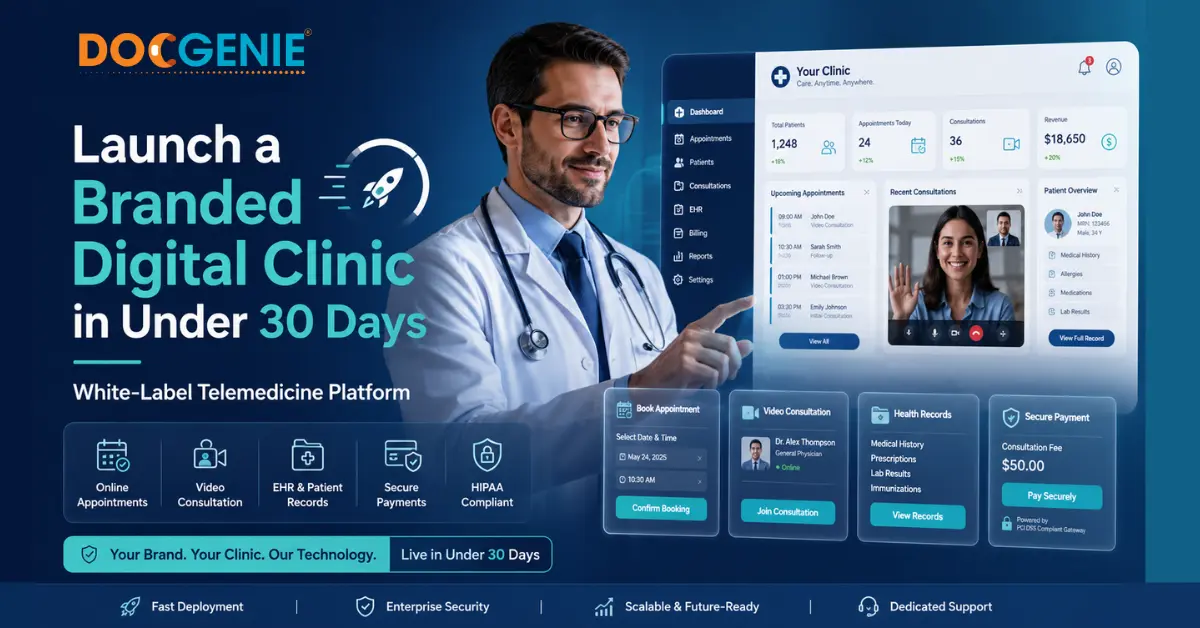
Launch a Branded Digital Clinic in 30 Days | DocGenie Global
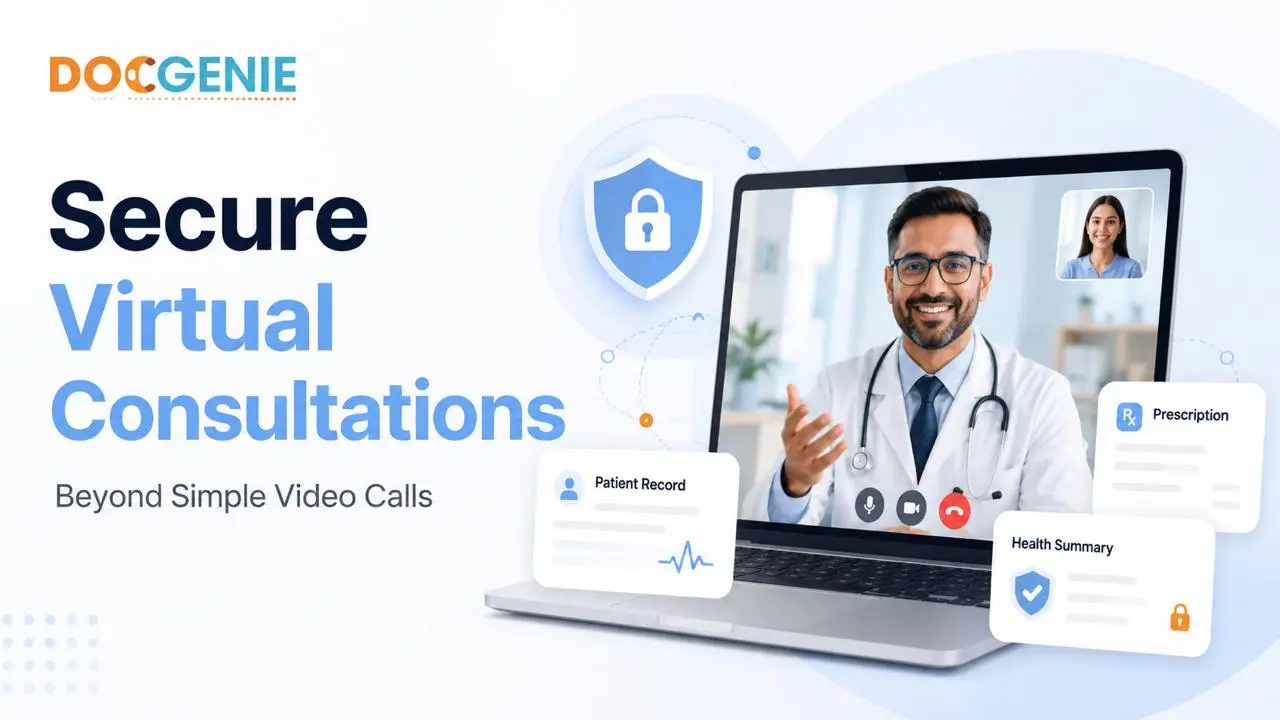
Secure Virtual Consultations Beyond Video Calls
Ready to enhance your telehealth services?
Discover how DocGenie Global can help you deliver superior virtual care experiences to your patients.