
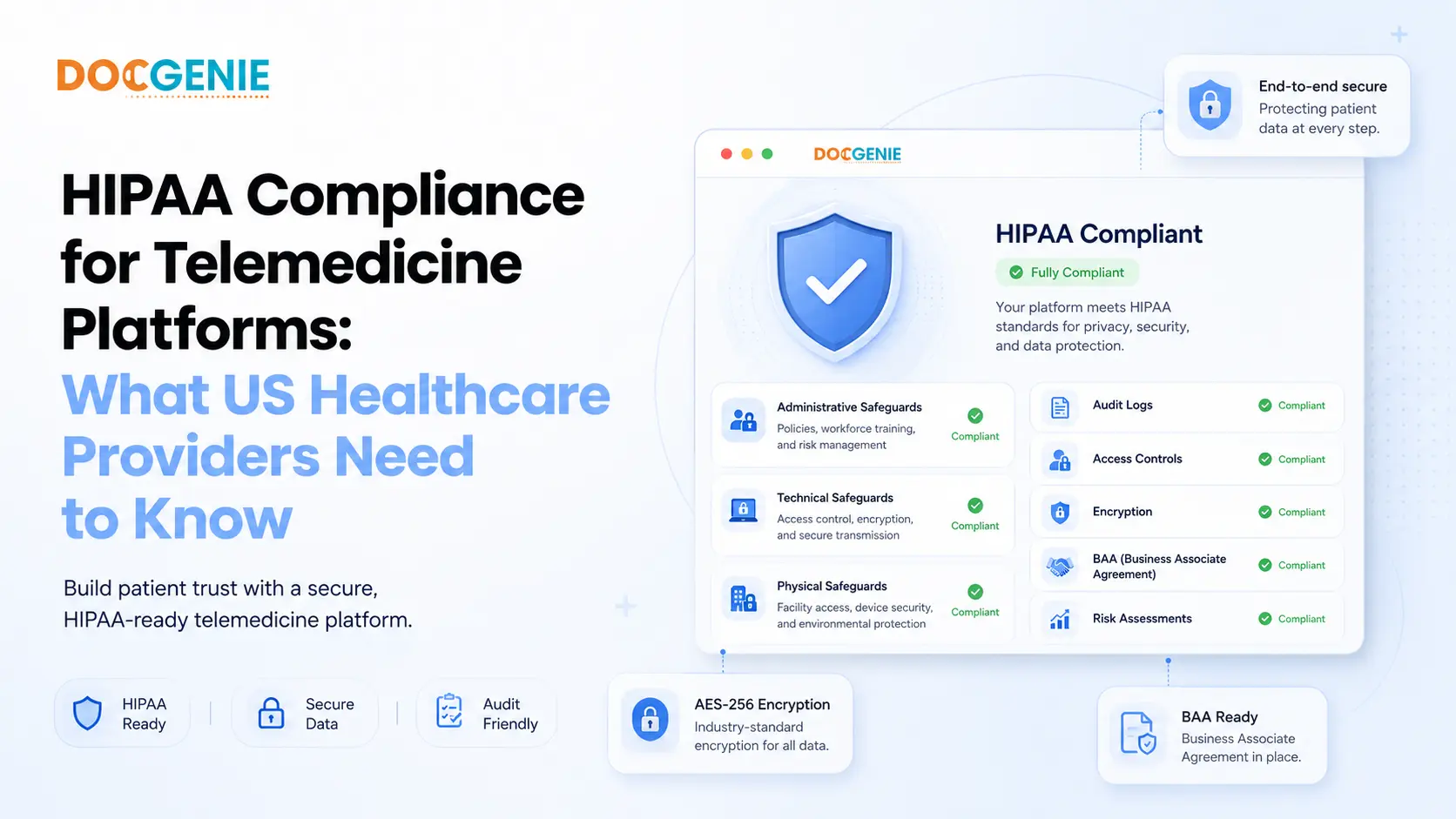
HIPAA Telehealth Compliance: 2026 US Guide

Founder & Medical Director, DocGenie Global · MD (Family Medicine) · USC California · 30+ years of experience
Table of Contents
Introduction
HIPAA compliance for telemedicine means more than secure video. Across the virtual care journey — patient registration, appointment booking, consultation, post-visit communication, and data storage — a telehealth platform typically handles electronic protected health information (ePHI). Understanding what HIPAA actually requires of covered entities and their vendors helps US healthcare providers ask the right questions when selecting a white label telemedicine platform for US healthcare organizations.
Quick Answer: Is a Telehealth Platform 'HIPAA Compliant'?
No government agency certifies a product as "HIPAA compliant," and no platform is compliant on its own simply because of its features. HIPAA obligations fall on covered entities (such as healthcare providers) and their business associates (vendors that handle protected health information on their behalf).
Whether telehealth is delivered in a HIPAA-compliant way depends on several things together: the covered entity's own policies and risk analysis, whether an appropriate Business Associate Agreement (BAA) is in place with each vendor that handles ePHI, the administrative, physical, and technical safeguards that are actually implemented, how the tools are configured, and how staff use them. A platform can *support* compliance; it cannot make an organisation compliant by itself.
The HIPAA Rules That Apply to Telehealth
HIPAA-covered entities and their business associates must comply with the applicable HIPAA Rules. Three are especially relevant to telehealth:
The Privacy Rule governs how protected health information (PHI) — in any form — may be used and disclosed. In telehealth, this shapes how consultation records, appointment history, and patient communications are accessed and shared, and limits disclosures to permitted purposes such as treatment, payment, and healthcare operations. See the HHS Privacy Rule overview.
The Security Rule applies specifically to electronic PHI (ePHI) and sets administrative, physical, and technical safeguard standards for protecting it. For a telehealth platform this is where authentication, audit logging, access controls, and transmission protections come into play.
The Breach Notification Rule requires covered entities to notify affected individuals and the U.S. Department of Health and Human Services (HHS) when unsecured PHI is acquired, accessed, used, or disclosed in a way not permitted by the Privacy Rule. In practice, your vendor should have a documented breach-response process and a contractual duty to notify you promptly.
These Rules apply to covered entities and their business associates — not to every company or every health-related message in the abstract. HHS maintains dedicated guidance on HIPAA and telehealth. Because a telehealth vendor that handles ePHI is generally a business associate, vendor selection is a compliance decision, not only a technology one.
Business Associate Agreements (BAAs) and the Narrow Conduit Exception
A vendor that creates, receives, maintains, or transmits PHI on behalf of a covered entity is generally a business associate under HIPAA. A telehealth vendor that stores or processes ePHI therefore generally requires an appropriate, signed Business Associate Agreement (BAA) before patient data flows through its systems. HHS provides guidance on business associates.
A BAA typically defines:
The conduit exception is narrow. HHS has explained it is intended to exclude only entities that provide *mere* transmission services — couriers such as the U.S. Postal Service, and their electronic equivalents such as internet service providers providing only data transmission — where access to any PHI is transient and only as needed to transport it. A vendor that maintains or processes ePHI is not a conduit, even if it does not actually view or cannot decrypt the information. Ordinary telehealth software vendors — which store, process, or persistently handle ePHI — should not be assumed to qualify for this exception. When in doubt, treat the vendor as a business associate and put a BAA in place.
A telehealth vendor that cannot or will not sign an appropriate BAA should not be used to handle US patient data, regardless of its other capabilities.
Key Questions to Ask Any Telehealth Vendor
When evaluating a telehealth platform, ask these questions directly — and get documented answers:
How to Evaluate a Communication Tool for HIPAA
General-purpose video, messaging, and conferencing tools vary widely in whether — and how — they can be used with ePHI. Rather than assuming any named product is or isn't usable, evaluate each tool against the same questions:
HHS has issued specific guidance on remote communication technologies for audio-only telehealth that illustrates how these considerations apply. A tool is not "HIPAA compliant" in the abstract; suitability depends on the BAA, the configuration, and how your organisation uses it.
HIPAA Telehealth Evaluation Checklist for 2026
Use this as a starting framework — not a substitute for your own HIPAA risk analysis and legal review. The Security Rule groups safeguards into administrative, physical, and technical categories, and each specification is either "required" or "addressable." *Addressable does not mean optional:* it means you assess whether the safeguard is reasonable and appropriate for your environment, and if it is not, you document why and implement an equivalent alternative where reasonable and appropriate.
Administrative
Physical
Technical
Treat encryption as a strongly recommended safeguard to examine during vendor selection, while remembering its formal status under the Security Rule is addressable rather than an unconditional mandate in every circumstance.
HIPAA-Aligned vs. HIPAA-Certified: Understanding the Difference
No government body issues 'HIPAA certification.' When vendors claim to be 'HIPAA certified,' they are typically referring to third-party audits or self-assessments against HIPAA standards — not a formal government-issued credential. HIPAA compliance is not a certification you achieve and hold indefinitely; it is an ongoing operational commitment.
What actually matters:
HIPAA compliance is a shared responsibility between your organisation and your technology partners. A vendor can support your compliance, but it cannot make you compliant in isolation.
Security Rule Technical Safeguards for Telehealth Platforms
The HIPAA Security Rule's technical safeguards are particularly relevant to telehealth platforms. The Rule's standards and implementation specifications are set out in the HHS Security Rule guidance. When evaluating a vendor, ask specifically how it addresses each, and note which underlying specifications are "required" and which are "addressable":
These safeguards are regulatory considerations under the Security Rule, applied through your organisation's risk analysis — not a fixed checklist where every item is unconditionally mandatory in every circumstance. What a telehealth vendor's platform should do is *support* the safeguards your risk analysis calls for.
DocGenie Global and HIPAA Alignment
DocGenie Global is designed to support HIPAA-aligned virtual care workflows for US healthcare providers, with privacy-focused architecture, role-based access controls, secure data handling, and BAA availability. Final HIPAA compliance depends on your organisation's implementation, processes, and configuration — as it does with any platform. For a broader look at HIPAA best practices in telemedicine, see our guide on HIPAA Compliance Best Practices for Healthcare Providers.
Conclusion
Learn when a BAA is required, how HIPAA applies to telehealth, and what US healthcare providers should evaluate when selecting a telehealth platform vendor. HIPAA compliance is a shared responsibility between your organisation and your technology partners, not a badge a product carries on its own. The right white label telemedicine partner understands its role as a business associate, signs an appropriate BAA before patient data flows through its systems, documents its safeguards, and sustains those commitments over time. Note that HIPAA violations can carry tiered civil monetary penalties based on the level of culpability, with applicable annual caps, and potential criminal penalties in serious cases; HHS periodically adjusts the relevant monetary amounts, and the HHS Office for Civil Rights enforces HIPAA. Evaluating vendors through this lens — before comparing feature lists — is how US healthcare providers protect their patients and their organisations.
For a platform overview aimed at American providers, see our HIPAA-aligned white label telemedicine platform for the US market, and for buyer context see our white label telemedicine platform pricing guide.
Frequently Asked Questions
What HIPAA rules apply to telemedicine platforms?
Telemedicine platforms that handle Protected Health Information (PHI) must comply with the HIPAA Privacy Rule, Security Rule, and Breach Notification Rule. This includes administrative, physical, and technical safeguards for PHI, as well as secure communication channels and audit controls.
What is a Business Associate Agreement (BAA) and why do I need one for telemedicine?
A Business Associate Agreement is a required contract between a HIPAA-covered entity and any vendor that creates, receives, maintains, or transmits PHI on its behalf. If your telemedicine platform stores or processes patient data, a signed BAA with the vendor is a HIPAA requirement.
Is video consultation software automatically HIPAA compliant?
No. General consumer video tools are not automatically HIPAA compliant. For telemedicine to meet HIPAA requirements, the platform must include encryption, access controls, audit logs, and a signed BAA — and the vendor must be willing and able to enter into a BAA.
What is Protected Health Information (PHI) in the context of telehealth?
PHI includes any individually identifiable health information transmitted or maintained by a covered entity. In telemedicine this includes video consultation recordings, clinical notes, diagnostic codes, prescription data, appointment records, and patient contact details tied to health information.
What are the penalties for HIPAA non-compliance in telemedicine?
HIPAA violations can carry tiered civil monetary penalties based on the level of culpability, with applicable annual caps, and potential criminal penalties in serious cases. HHS periodically adjusts the relevant monetary amounts, and the HHS Office for Civil Rights enforces HIPAA.
Is a BAA always required for telemedicine?
Almost always, when the vendor handles ePHI. A vendor that creates, receives, maintains, or transmits protected health information on a covered entity's behalf is generally a business associate and needs a signed BAA. The conduit exception is narrow — it covers mere transmission services with only transient access to data, not vendors that store or process ePHI. When in doubt, treat the vendor as a business associate and put a BAA in place.
How should a healthcare provider evaluate a communication tool for HIPAA?
Evaluate each tool on the same criteria rather than assuming it is or is not usable: whether the vendor will sign an appropriate BAA, what service tier and configuration are required, how PHI is protected in transit and storage, what access controls, authentication, and audit capabilities exist, the vendor's data-retention and breach-response processes, and whether your own risk analysis supports the intended use.
What makes a telehealth platform suitable for HIPAA-regulated use?
Suitability comes from a combination of factors, not product features alone: an appropriate BAA with the vendor, support for the administrative, physical, and technical safeguards your risk analysis calls for, correct configuration, and how your organisation uses the platform. HIPAA is not a certification a product holds on its own — the covered entity and its business associates share responsibility for compliance.
Related Articles

Is Telemedicine Legal in South Africa? HPCSA Telemedicine Guidelines Explained (2026)

7 Benefits of Integrating a White-Label Telemedicine Solution for Clinics and Hospitals