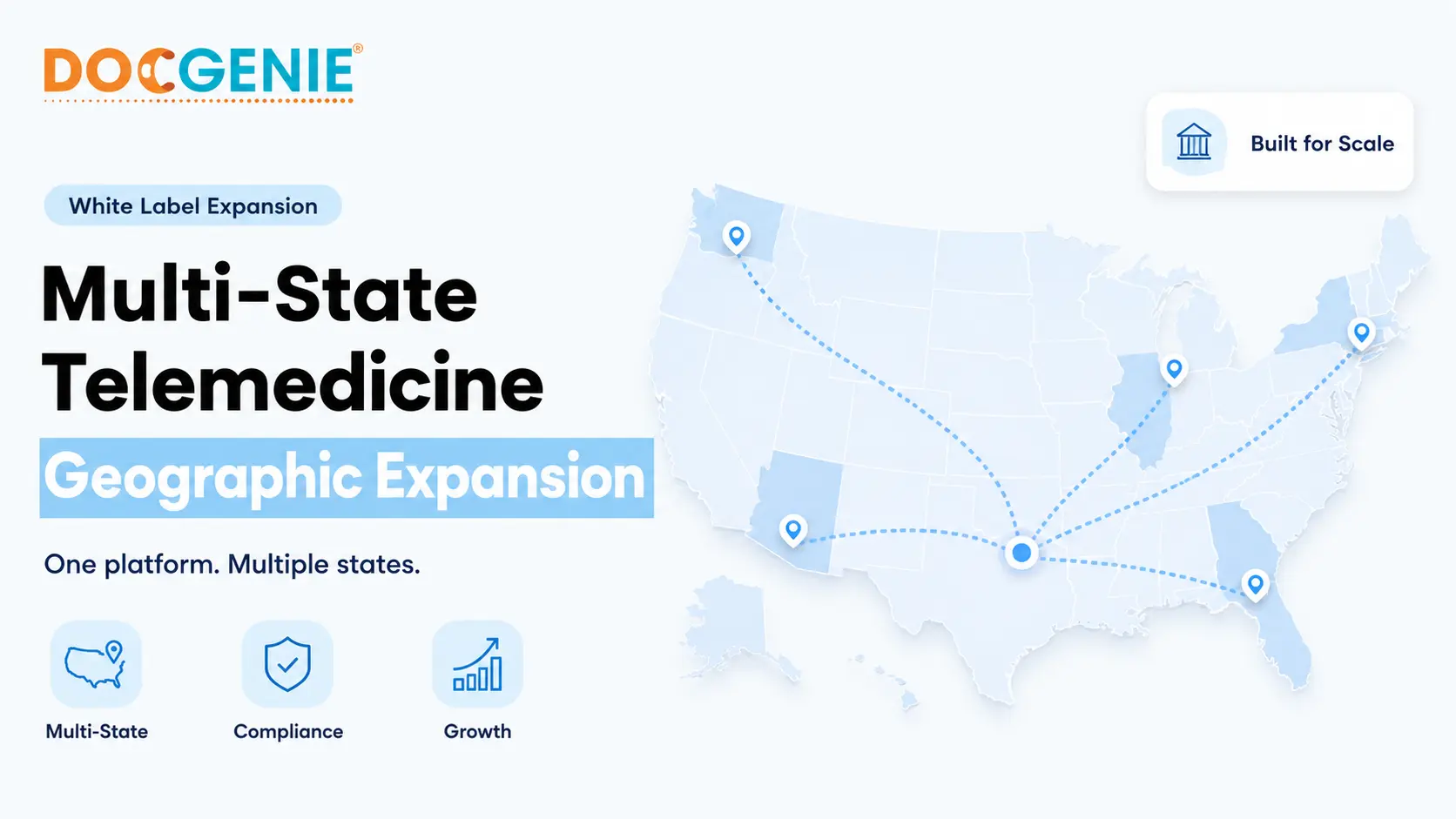
Multi-State Telemedicine: How White Label Platforms Support Geographic Expansion

Founder & Medical Director, DocGenie Global · MD (Family Medicine) · USC California · 30+ years of experience
Table of Contents
Introduction
Multi-state telemedicine allows US healthcare providers to serve patients across state lines without physical expansion — but it introduces provider licensure obligations, varying state regulations, and platform requirements that differ significantly from single-location virtual care. For healthcare organisations evaluating geographic expansion through a white label telemedicine platform built for US providers, understanding both the regulatory and technology dimensions of multi-state operation is essential planning work.
What Multi-State Telemedicine Involves Operationally
Expanding virtual care across state lines introduces regulatory complexity that does not exist in single-state operation:
Provider licensure: Under US law, the standard is that providers must be licensed in the state where the patient is located at the time of consultation — not where the provider's office is based. A physician licensed in California treating a patient who is physically in Texas at the time of the visit is generally required to hold a Texas medical licence.
Interstate Medical Licensure Compact (IMLC): The IMLC simplifies multi-state licensure for qualifying physicians. As of 2025, the Compact covers 40+ US states and territories. Qualifying physicians can obtain licences in multiple member states through a streamlined application process rather than completing separate full applications in each state. Not all providers qualify, and not all states participate — so check current membership and requirements before building a licensure strategy.
Varying state telehealth regulations: Individual states may impose requirements beyond federal HIPAA standards — including informed consent documentation, specific audio-video requirements for certain consultation types, prescribing restrictions via telemedicine, and documentation standards. These vary by state and change periodically.
Multi-timezone scheduling: Coordinating appointments across time zones requires scheduling infrastructure that handles display and booking clearly for both patients and providers across geographies.
What Your Telemedicine Platform Must Support for Multi-State Expansion
From a platform perspective, multi-state virtual care requires capabilities that single-location deployments may not need:
Why Brand Consistency Matters More at Scale
When your virtual care service operates across multiple states, brand consistency becomes a trust and operational requirement — not just a marketing preference.
Patients in different geographies should not experience different-looking platforms, inconsistent communication styles, or varying care journey standards depending on which state they are in or which provider they see. Inconsistency creates confusion and erodes the credibility of your service at exactly the moment when you are trying to build it in a new market.
A white label telemedicine platform ensures that your brand standards — logo, colours, domain, communication templates, and patient portal experience — are applied consistently across every patient interaction, regardless of geography. For organisations expanding into new states, this consistency is part of what distinguishes a professional virtual care programme from a fragmented rollout.
Planning Your Licensure Strategy Before Deploying Technology
Multi-state telemedicine works best when the licensure and regulatory strategy is defined before the technology deployment begins. Starting technology configuration without knowing which states you are targeting leads to rework when state-specific requirements emerge later.
Key questions to answer before selecting and configuring your platform:
How to Scale: From One State to Many
The most effective approach to multi-state telemedicine expansion is to establish a strong foundation in your home state before expanding. Prove the operational model, refine the patient experience, and train staff on virtual care workflows — then expand.
Expanding too early — before the operational model is refined — means scaling problems alongside scaling geography. Common issues in premature multi-state expansion include:
A white label platform built for scalability supports a disciplined expansion by allowing you to add providers, locations, appointment types, and state-specific configuration without rebuilding the patient-facing experience each time. The platform grows with your licensure strategy — not ahead of it.
Multi-State Telemedicine for Employer and Network Models
Multi-state virtual care is particularly valuable in two specific business models that do not map neatly onto traditional geographic practice expansion:
Employer-sponsored virtual care: Employers with workforces distributed across multiple states increasingly want to offer virtual care access as an employee benefit. This requires a platform that can serve patients in many states without requiring separate per-state deployments, and a provider network with appropriate licensure coverage.
Provider networks and health systems: Large multi-location health systems and provider networks operate across multiple states by definition. For these organisations, a white label platform that supports multi-location management under a single branded interface — with granular administrative controls — is a core operational requirement, not a nice-to-have.
Conclusion
Multi-state telemedicine is one of the most powerful growth strategies available to US healthcare organisations — but it requires both an operational and a technology foundation that can support geographic complexity. A white label telemedicine platform that handles multi-provider management, branded consistency, and flexible configuration across locations gives expanding healthcare organisations the infrastructure they need to scale without losing the patient trust they have built. For compliance requirements across states, see our guide on HIPAA Compliance for Telemedicine Platforms.
Frequently Asked Questions
What medical licensing is required to practise telemedicine across US states?
Physicians must generally hold a valid medical licence in the state where the patient is located at the time of the telehealth encounter, not only in the state where the provider is based. Requirements vary by state and specialty. Some states have adopted telehealth-specific expedited licence pathways.
What is the Interstate Medical Licensure Compact (IMLC)?
The IMLC is a voluntary agreement among participating US states and territories that streamlines the process for eligible physicians to obtain licences in multiple member states. Physicians who meet eligibility criteria can apply for licences in multiple IMLC member states through a single application process. Eligibility and membership vary — providers should verify current state participation on the IMLC website.
How can a white-label telemedicine platform support multi-state operations?
A scalable white-label platform can support multi-state operations through provider management tools that assign state-specific credentials, configurable workflows that adapt to state-specific telehealth requirements, and centralised reporting across all locations under a single branded environment.
What compliance considerations apply to multi-state telemedicine?
Compliance requirements in multi-state telemedicine include state-specific medical licensure, varying telehealth coverage and parity laws, state-specific prescribing regulations, and data residency obligations. Healthcare organisations expanding across states should conduct a state-by-state regulatory review or work with legal counsel with telehealth expertise.
Does expanding telemedicine across states require separate technology platforms?
No. A well-architected white-label telemedicine platform should support multi-state and multi-provider operations from a single platform, with configurable access controls, provider credentialing by location, and state-specific workflow support — all under one branded patient experience.
Related Articles
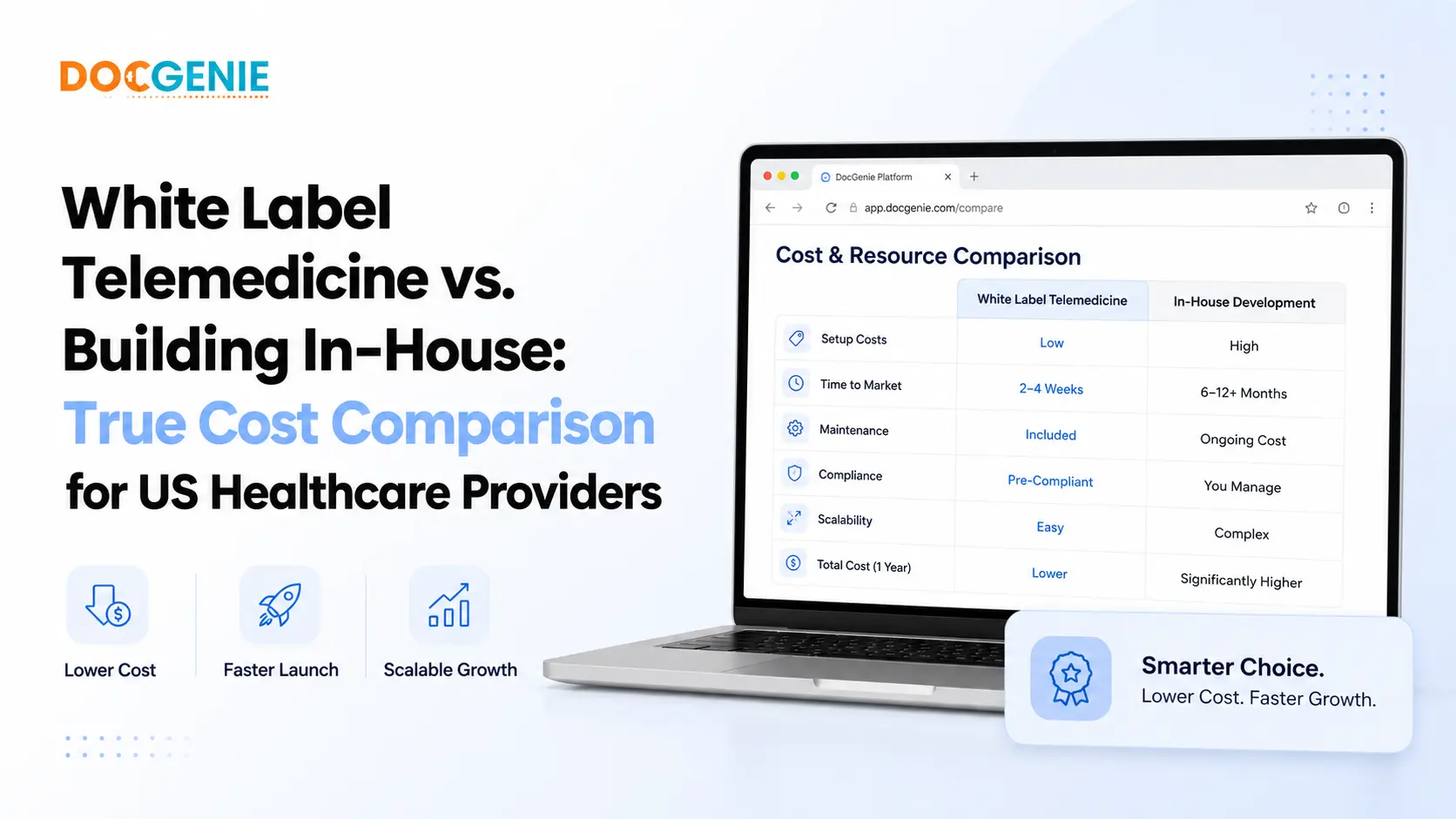
White Label Telemedicine vs. Building In-House: True Cost Comparison for US Healthcare Providers